

Securing the Bookends: How Spencer Fano and Austin Barber Fit the Browns’ Frantic Offensive Line Overhaul
Andrew Berry has pulled off his fair share of "laser eye" meme-worthy magic during his tenure in Cleveland. But the Browns’ general manager's kryptonite has undoubtedly been the offensive line.
For years, the writing was on the wall. The Browns' once-elite offensive trench was rapidly aging out and physically declining, yet the front office approached the position with a mix of neglect, negligence and mid-round band-aids. Berry’s track record here is decidedly checkered. His first major swing, selecting Jedrick Wills Jr. with the 10th overall pick in 2020, failed to materialize into franchise left tackle production. Wills is no longer on the team and spent last year sitting out of the NFL entirely. Nick Harris, a third-round selection in that same draft, failed to become the team's long-term center, as was hoped. More recent mid-to-late-round fliers like Buckeyes Dawand Jones and Luke Wypler and Wolverine Zac Zinter are now fighting just to retain their roster spots.
By 2025, the Browns' neglect caught up to them. The offensive line devolved into an unplayable turnstile in pass defense and an obstacle in the run game, forcing Berry into a frantic overhaul this spring. The final pieces of that puzzle just arrived via the NFL Draft: offensive tackles Spencer Fano and Austin Barber and center Parker Brailsford, who is discussed in an earlier article.
Here is a look at how the bookend rookie tackles fit into Cleveland's newly reconstructed trench.
The 2025 Disaster: A Historically Bad Baseline
To understand the urgency behind Berry’s draft strategy, you have to look at the wreckage of last season. According to Pro Football Focus (PFF), the 2025 Browns surrendered a pressure rate on 39.1% of their dropbacks—the second worst mark in the NFL. The tackles were particularly poor, allowing a league-high 143 pressures and posting the lowest cumulative pass-blocking grade in the league at 44.1. Think of it this way. The Cleveland Browns' defensive line led the league in overall pressure rate at 34.9%, according to FTN Data. The average defense playing against the Browns' offensive line bettered this by a significant margin.
But the offensive line’s ineptitude was just as glaring in the rushing data. Rookie running back Quinshon Judkins was routinely met by defenders the moment he was handed the football. Data tracked by NFL Next Gen Stats illustrates a grim reality: Judkins had to create his own yardage in his valiant effort to keep the offense afloat.
| Running Back |
Total Rushing Yards |
Yards After Contact (YCO) |
% of Yards After Contact |
|---|---|---|---|
| Quinshon Judkins |
827 | 636 | 77% |
| Derrick Henry |
1,595 | 1,107 | 69.4% |
| Christian McCaffrey |
1,202 | 859 | 71.0% |
The Bears Blueprint: A Free Agency Frenzy
Realizing the draft alone could not fix the mess, Berry deployed a strategy heavily inspired by Ryan Poles' rebuild of the Chicago Bears: pay premium money for proven, highly athletic interior linemen, hire a veteran line coach, and draft tackles.
The Browns brought in highly respected offensive line coach George Warhop to stabilize the room. Then, they opened the checkbook. Cleveland secured Tytus Howard, Zion Johnson, and Elgton Jenkins, while bringing back Teven Jenkins on a new deal.
The clear common denominator? Athleticism. The free-agent additions posted an average Relative Athletic Score (RAS) in the 88th percentile compared to the NFL starter average. Berry solidified the middle with explosive movers, allowing him to target two specific tackles in the draft to cap off the rebuild.
Spencer Fano: The Day One Left Tackle
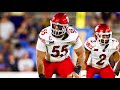
Spencer Fano arrives from Utah with an undeniable pedigree. Fano is a fluid, explosive mover who easily mirrors pass rushers in space. His RAS profile aligns perfectly with Berry's new athletic standard, showcasing lateral quickness that makes him a natural fit for zone-blocking schemes.
However, Fano comes with one glaring question mark: his wingspan. Measuring with sub-33-inch arms, traditional scouting metrics suggest a permanent move inside to guard. Operating on the edge against long, bendy NFL pass rushers with a condensed wingspan is a difficult way to make a living. The arm-length cutoff for Left tackles is usually 34 inches.
Fortunately, Fano isn't the first player to attempt to buck this trend.
| Drafted Tackle |
Arm Length |
NFL Position |
Career Outcome |
|---|---|---|---|
| Joe Thomas |
33.75" | Left Tackle | Hall of Fame (Elite footwork compensated for reach). |
| Rashawn Slater |
33.00" | Left Tackle | All-Pro caliber starter. |
| Peter Skoronski |
32.25" | Left Guard | Kicked inside strictly due to length; solid starter. |
| Will Campbell |
32.62" | Left Tackle | Scrutinized during the 2025 playoffs, allowing multiple sacks and pressures. |
The Browns are betting that Fano's technical refinement and quick feet can overcome the physical limitation—much like a certain legendary Browns tackle named Joe Thomas did. Fano is firmly on track to be the day-one starter protecting the blindside, but he must demonstrate early in camp that he can anchor against power rushers who will inevitably try to get their hands inside his chest plate.
Austin Barber: The Value Pick and Swing Tackle Battle
While Fano was a premium selection, Florida’s Austin Barber represented an exercise in patience. Widely expected to hear his name called a full round earlier, Barber slid down the board right into Cleveland's lap.
Where Fano wins with finesse and technique, Barber wins with brute force. He is a mauler in the run game, utilizing a nasty disposition to clear lanes. However, Barber slid in the draft due to concerns about his pass-protection consistency. He occasionally gets top-heavy and over-extends, leaving him susceptible to speed rushers bending the edge.
Barber won't be handed a starting role immediately. Instead, he will enter a fierce camp battle with Dawand Jones for the swing tackle position. Barber must demonstrate improved patience in his pass sets under Coach Warhop’s tutelage to get on the playing field.
The Outlook
Playing offensive tackle as a rookie in the NFL is a notoriously difficult transition. Edge rushers are faster, defensive coordinators are less forgiving, and the playbook complexities are steep. Both Fano and Barber will experience growing pains.
But after the unwatchable disaster of the 2025 offensive line, Cleveland doesn’t need perfection right out of the gate. They need aggressive, athletic stability. If Berry’s newly minted trench holds up, the Browns' quarterbacks and running backs will finally have a chance to keep the pocket clean—rather than having to clean out their lockers in January.
 Reviewed by AT Dawgger
on
9:29 AM
Rating:
Reviewed by AT Dawgger
on
9:29 AM
Rating:


No comments: